University robotics team projects (freshman & sophomore years)
Contents
Projects on the university robotics team
I joined the university’s robotics team in my freshman year and kept building up my engineering and algorithm skills across a series of competitions.
A grayscale line-following board
We found that robots following a line outdoors, or under complicated lighting, are easily disturbed by external light — sunlight above all. So I set out to design a line-following board that could reject external light interference.
The design of this dynamically sunlight-resistant board came down to:
- A differential method that dynamically switches the on-board light source off: first measure the ambient light level, then switch the emitter on to read the reflected intensity. Subtracting the two gives the true reflection produced by the on-board source, which suppresses the influence of external light.
- Otsu’s method to dynamically calibrate the threshold between the white line and the black background.
- The project was granted a national utility model patent and has been in continuous use across the team’s robotics competitions.
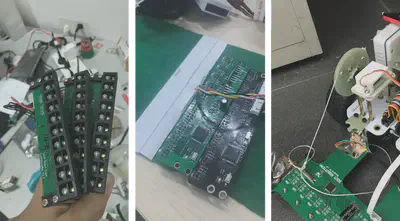
How the board performs under real outdoor sunlight:
Short-range robot localization
This project implemented a localization algorithm built on encoder motors, a gyroscope and a laser rangefinder, fused with an Extended Kalman Filter. By folding in the encoder data, the robot achieves centimeter-level indoor localization at 50Hz even though the laser sensor only runs at 10Hz.
Algorithm testing and visualization:
The same localization algorithm running in an actual competition:
Jetson and YOLO
A road vehicle-counting algorithm built on the Jetson Nano and YOLOv4-tiny.
- Used TensorRT to reach over 18fps on the edge device while staying under 15W.
- Built the data visualization interface on the Node-RED framework.